consider the function graphed below. at what x-values does the function appear to not be continuous?
As function of exploring how functions change, we can identify intervals over which the office is changing in specific ways. Nosotros say that a part is increasing on an interval if the function values increment every bit the input values increase within that interval. Similarly, a role is decreasing on an interval if the function values decrease as the input values increase over that interval. The boilerplate rate of change of an increasing part is positive, and the average rate of change of a decreasing function is negative. Effigy 3 shows examples of increasing and decreasing intervals on a function.
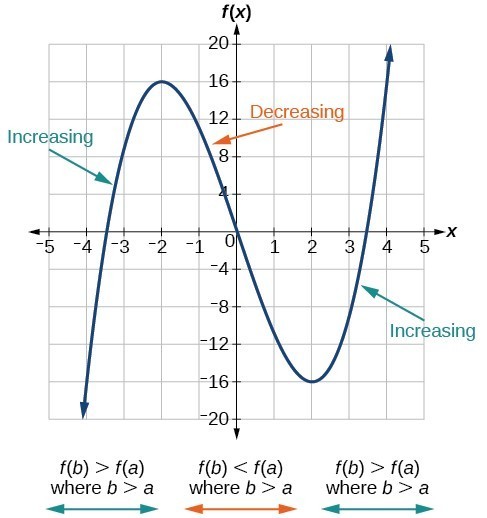
Figure 3. The function [latex]f\left(x\right)={x}^{3}-12x[/latex] is increasing on [latex]\left(-\infty \text{,}-\text{2}\right){{\cup }^{\text{ }}}^{\text{ }}\left(ii,\infty \right)[/latex] and is decreasing on [latex]\left(-2\text{,}two\correct)[/latex].
This video further explains how to find where a role is increasing or decreasing.
While some functions are increasing (or decreasing) over their unabridged domain, many others are not. A value of the input where a function changes from increasing to decreasing (as we become from left to correct, that is, as the input variable increases) is called a local maximum. If a function has more than ane, we say it has local maxima. Similarly, a value of the input where a function changes from decreasing to increasing as the input variable increases is called a local minimum. The plural course is "local minima." Together, local maxima and minima are called local extrema, or local farthermost values, of the role. (The singular form is "extremum.") Often, the term local is replaced by the term relative. In this text, nosotros will employ the term local.
Conspicuously, a office is neither increasing nor decreasing on an interval where it is constant. A function is also neither increasing nor decreasing at extrema. Annotation that nosotros have to speak of local extrema, because any given local extremum as defined here is non necessarily the highest maximum or lowest minimum in the function's entire domain.
For the role in Effigy 4, the local maximum is xvi, and it occurs at [latex]x=-2[/latex]. The local minimum is [latex]-16[/latex] and it occurs at [latex]x=ii[/latex].
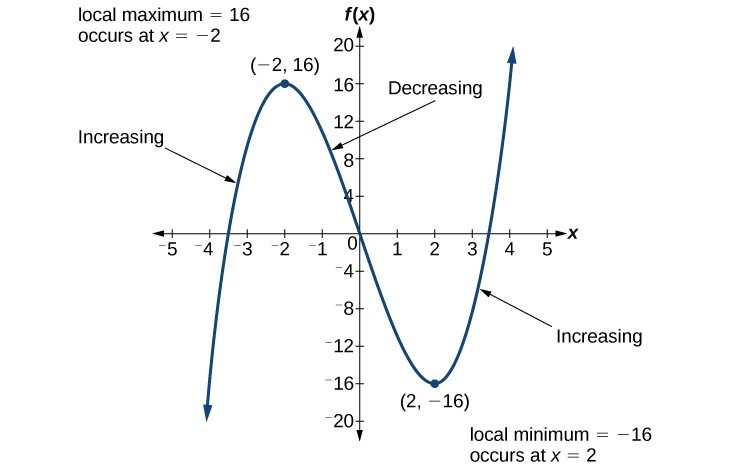
Effigy 4
To locate the local maxima and minima from a graph, we need to observe the graph to determine where the graph attains its highest and lowest points, respectively, inside an open interval. Like the tiptop of a roller coaster, the graph of a function is college at a local maximum than at nearby points on both sides. The graph will besides exist lower at a local minimum than at neighboring points. Figure 5 illustrates these ideas for a local maximum.
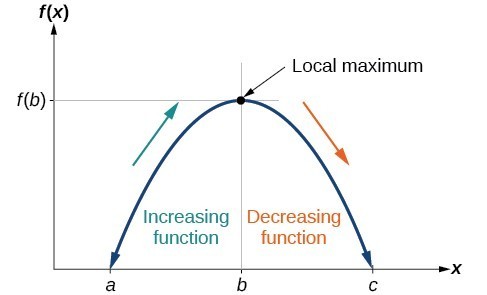
Effigy 5. Definition of a local maximum.
These observations pb us to a formal definition of local extrema.
A General Note: Local Minima and Local Maxima
A function [latex]f[/latex] is an increasing function on an open interval if [latex]f\left(b\right)>f\left(a\right)[/latex] for whatever ii input values [latex]a[/latex] and [latex]b[/latex] in the given interval where [latex]b>a[/latex].
A function [latex]f[/latex] is a decreasing function on an open interval if [latex]f\left(b\right)<f\left(a\correct)[/latex] for any two input values [latex]a[/latex] and [latex]b[/latex] in the given interval where [latex]b>a[/latex].
A function [latex]f[/latex] has a local maximum at [latex]x=b[/latex] if in that location exists an interval [latex]\left(a,c\correct)[/latex] with [latex]a<b<c[/latex] such that, for any [latex]x[/latex] in the interval [latex]\left(a,c\right)[/latex], [latex]f\left(x\right)\le f\left(b\correct)[/latex]. Likewise, [latex]f[/latex] has a local minimum at [latex]x=b[/latex] if in that location exists an interval [latex]\left(a,c\correct)[/latex] with [latex]a<b<c[/latex] such that, for whatever [latex]10[/latex] in the interval [latex]\left(a,c\right)[/latex], [latex]f\left(10\right)\ge f\left(b\correct)[/latex].
Case vii: Finding Increasing and Decreasing Intervals on a Graph
Given the function [latex]p\left(t\right)[/latex] in the graph below, identify the intervals on which the function appears to be increasing.
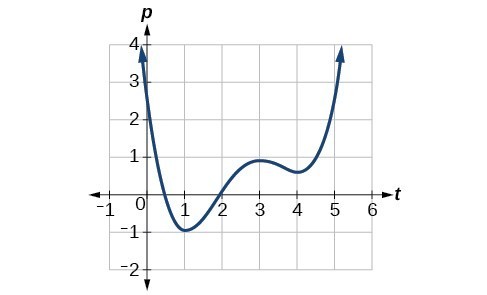
Effigy six
Solution
Nosotros see that the part is non abiding on any interval. The office is increasing where it slants upward as we move to the correct and decreasing where it slants downwards equally nosotros move to the right. The part appears to be increasing from [latex]t=1[/latex] to [latex]t=3[/latex] and from [latex]t=four[/latex] on.
In interval note, we would say the function appears to be increasing on the interval (1,3) and the interval [latex]\left(4,\infty \right)[/latex].
Example viii: Finding Local Extrema from a Graph
Graph the role [latex]f\left(ten\right)=\frac{two}{x}+\frac{x}{3}[/latex]. Then employ the graph to estimate the local extrema of the office and to decide the intervals on which the part is increasing.
Solution
Using technology, we find that the graph of the function looks like that in Figure 7. It appears there is a low point, or local minimum, between [latex]x=two[/latex] and [latex]x=3[/latex], and a mirror-image high betoken, or local maximum, somewhere between [latex]10=-iii[/latex] and [latex]x=-2[/latex].
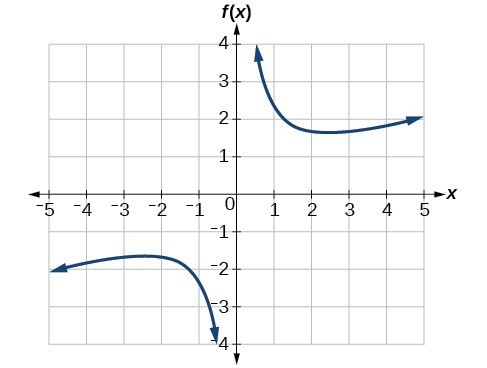
Effigy 7
Endeavour It 4
Graph the function [latex]f\left(x\right)={ten}^{3}-6{x}^{2}-15x+xx\\[/latex] to approximate the local extrema of the function. Utilise these to determine the intervals on which the function is increasing and decreasing.
Solution
Example nine: Finding Local Maxima and Minima from a Graph
For the function [latex]f[/latex] whose graph is shown in Figure nine, find all local maxima and minima.
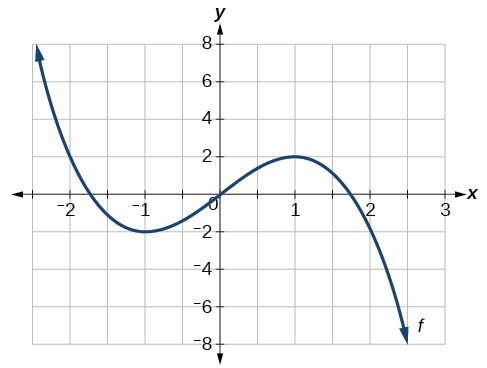
Figure 9
Solution
Find the graph of [latex]f[/latex]. The graph attains a local maximum at [latex]x=1[/latex] because it is the highest bespeak in an open interval effectually [latex]x=1[/latex]. The local maximum is the [latex]y[/latex] -coordinate at [latex]x=1[/latex], which is [latex]2[/latex].
The graph attains a local minimum at [latex]\text{ }x=-ane\text{ }[/latex] considering it is the lowest point in an open interval around [latex]x=-i[/latex]. The local minimum is the y-coordinate at [latex]x=-ane[/latex], which is [latex]-2[/latex].
Analyzing the Toolkit Functions for Increasing or Decreasing Intervals
We will now return to our toolkit functions and discuss their graphical behavior in the table below.
| Office | Increasing/Decreasing | Example |
|---|---|---|
| Constant Office [latex]f\left(x\right)={c}[/latex] | Neither increasing nor decreasing | 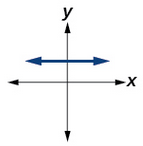 |
| Identity Function [latex]f\left(x\right)={10}[/latex] | Increasing | 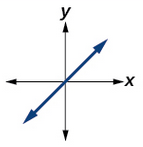 |
| Quadratic Function [latex]f\left(x\right)={10}^{2}[/latex] | Increasing on [latex]\left(0,\infty\correct)[/latex] Decreasing on [latex]\left(-\infty,0\right)[/latex] Minimum at [latex]x=0[/latex] | 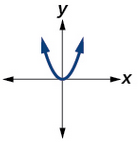 |
| Cubic Office [latex]f\left(x\right)={x}^{3}[/latex] | Increasing | 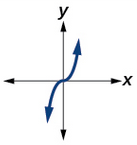 |
| Reciprocal [latex]f\left(x\correct)=\frac{1}{ten}[/latex] | Decreasing [latex]\left(-\infty,0\right)\cup\left(0,\infty\correct)[/latex] | 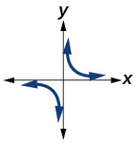 |
| Reciprocal Squared [latex]f\left(ten\right)=\frac{1}{{x}^{2}}[/latex] | Increasing on [latex]\left(-\infty,0\right)[/latex] Decreasing on [latex]\left(0,\infty\right)[/latex] | 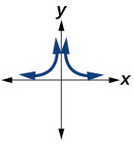 |
| Cube Root [latex]f\left(x\right)=\sqrt[iii]{x}[/latex] | Increasing | 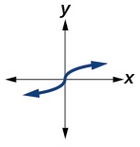 |
| Square Root [latex]f\left(x\right)=\sqrt{x}[/latex] | Increasing on [latex]\left(0,\infty\right)[/latex] | 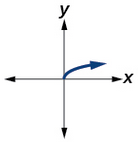 |
| Absolute Value [latex]f\left(ten\right)=|x|[/latex] | Increasing on [latex]\left(0,\infty\right)[/latex] Decreasing on [latex]\left(-\infty,0\right)[/latex] | 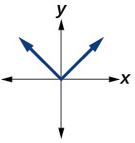 |
Source: https://courses.lumenlearning.com/ivytech-collegealgebra/chapter/use-a-graph-to-determine-where-a-function-is-increasing-decreasing-or-constant/
0 Response to "consider the function graphed below. at what x-values does the function appear to not be continuous?"
Отправить комментарий